
The Basics of Music Theory for Guitar
May 23, 2026
When I first starting learning how to play the guitar I can remember feeling lost and not sure where to start. I spent many years only working on technique. My ability to read tablature and chord charts was enough to progress. At a certain point, I realized that technique alone was not going to be enough. If I wanted to play like the guitarist I looked up to, I was going to have to learn some theory.
So I set about scouring the Internet in search of knowledge about music theory. I’ve been at it awhile now, and though I’m not where I want to be, I’m a lot farther along than when I started. If you’d like to start that journey as well, I’d love to help you along the way. This article is the foundation. I’m going to start at the beginning and each article will build upon the previous.
Natural and Accidental Notes
When attempting to talk about music, we have to convey two main points of reference for any given instrument if we want to communicate to someone how to play a certain piece of music. The first is the pitch, or high/lowness of the note. The second is the duration of that note. In these first couple of articles we are not going to concern ourselves with the second reference point. Instead, we are going to focus on becoming very knowledgeable about the first, pitch.
In western music we divide all the possible pitches into twelve different buckets. The first seven letters of the alphabet, A-G, name seven of these buckets. The remaining five are named in reference to these other seven. They are either one step higher or one step lower than one of those seven notes. If a note is one step higher than one of those seven notes, it is said to be sharp. Therefore, the note one step higher than an A is known as an A sharp, written A#. If a note is one step lower than a note it is known as a flat. A note one step lower than a B would be a B flat, written Bb.
So these twelve notes would be as follows:
A A# B C C# D D# E F F# G G#
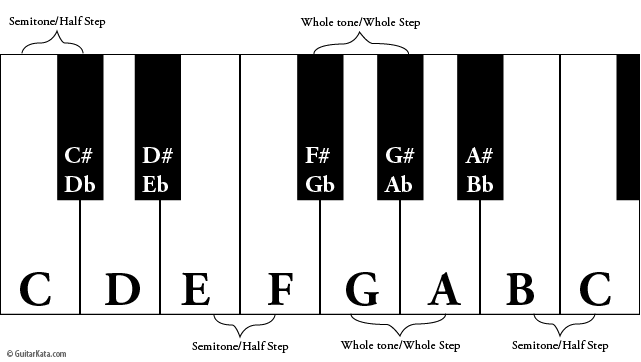
You’re probably scratching your head right about now. First off, there are no flats in this list. And second, what happened to B# and E#? To address this first point, let’s explain the relationship of sharps and flats, or accidentals, as they are known. The seven non-accidental notes, or natural notes, have one note in-between them (With the exception of B & C and E & F). This note in-between has two names. For example the note between A & B can either be known as an A# or a Bb. There is a rhyme and reason to when you call that note an A# and when you Call it a Bb, but for now just know that these two accidentals refer to the same note. I realize this is a bit confusing, let’s use a piano keyboard to clear this up.
The piano keyboard provides a great visual representation of the relationship between the natural and accidental notes. Figure BLANK depicts a section on a piano keyboard. Notice that the white keys all correspond to natural notes while the black keys correspond to accidentals. This is not an accident; western music theory was developed on the piano and piano-like instruments. Learning the basics of a piano layout can really help you grasp a lot of the concepts I’m going to discuss.
Now for this second question, where did our B#/Cb and E#/Fb go? I did a cursory amount of research into this and found that it mostly has to do with history. I think I’ll save that explanation for a later article and just explain the mechanics of it. To explain this in a way that is digestible, we must first define a couple more terms.
Semitones and Whole tones
To understand the lack of accidental between the B&C and E&F we must understand semitones and whole tones. A semi tone is the smallest distance between two notes in western music. It is the difference in pitch that you hear when you move from one fret to the next on the same string. We sometimes refer to this as a half step. In other words, for the guitar it is our smallest unit of measurement for pitch.
Whole tones, or whole steps, are two semitones. This is the difference in pitch between two frets on the same string. As you’ll learn in the next article, {The Major Scale for Guitarist}, we use semitones and whole tones to build scales, chords, and arpeggios.
So lets have a quick recap of what we’ve learned so far. There are twelve total notes in western music and they are made up of natural and accidental notes. When we compare the pitch of these notes, the smallest difference in pitch between one note and another is a semitone and two semitones equal a whole tone.
The doubtful among us may ask, “Okay, so that’s only twelve notes what about the other 100ish fret/string combinations on the guitar?” To explain this we need a new concept, the octave.
Octaves
Once you make your way through the twelve notes and arrive at G#, where do you go next? The answer is you start over at A. This new A is said to be an octave higher than the one you started on. As we said before, the difference in pitch between two frets on the same string is known as a half step. For example, the distance from the first fret on the top string and the second is a half step, or F to F#. Therefore, on any string the first eleven frets and the open string cover all the twelve notes on one octave. The twelfth fret is exactly one octave higher than the open string. You can continue this pattern up and down octaves until you reach pitches that can no longer be heard (Not on a guitar, obviously).
This, my friend, is how we can have so many different pitches on the guitar with only twelve names for them all. The octave allows us to reference more than twelve notes. So how do we know which octave is which? The answer is that there is a single starting point in western music called “Middle C”. We’ll get to why it’s called middle C in a later article, but for now just know that middle C is on the eight fret of the low E string and the third fret of the A string. If you’re not sure where those two places are, don’t worry we’ll cover that soon.
Why no B# and E#???
Okay, so we now have enough information to at least answer the mechanical reason of why there is no B# or E#. We’ll save the historical reason for another day. We now know that from an open string on the guitar to the twelfth fret on that same string is a difference in pitch of one octave. We also know that in western music a semitone is the smallest unit of measurement. Also, the difference in pitch between each semitone is the same, i.e. the distance from A to A# is the same as the distance from D to D# is the same as the distance from G to G# etc. Another way of saying this is that a semitone is 1/12 of an octave and in order to progress the entire octave by semitones, we don’t need the two extra semitones that seven natural notes create. The reason that the ones we drop are B#/Cb and E#/Fb will be a topic for another day and for our purposes, is not important.
So the take away from all of this is that you just need to commit to memory that there is no semitone between B and C or between E and F. Now that we have a basic understanding of notes and octaves, let’s see if we can move some of this knowledge over to the guitar!
Guitar tuning
The standard guitar has six strings with the following note values. The thinnest, bottom string is tuned to an E in standard tuning. The next thinnest string is a B, the third string is a G, the fourth a D, fifth an A, and the sixth and final string is also an E. To distinguish between the two E’s, first string and sixth string, the first string is often referred to as the “high E string” while the sixth, thickest, string is referred to as “low E”. This is due to the pitch of each string.
Notes of the guitar
So if we know that each open string has a note value and that there are two half steps between most natural notes, except between BC/EF, do we have enough information to fill in all the notes on the fret board? Yes! Starting on the low E string, the one at the top of the fret board (closest to your head), we know the open note is E. We also know that there is no E sharp, therefore, the first fret on the Low E string will be an F. Advancing to the second fret we’ll encounter our first sharp/flat, F#/Gb. Then the third fret will give us G. Following our pattern of two half steps between each natural note with the exception of BC/EF, we can fill in all the notes of the Low E string. Once we’re done, we can get a “two-for-one” deal because the high E string will use the exact same notes. See if you can repeat this exercise for every string on the guitar. Figure 3 below is a completed guitar neck.
{Guitar neck diagram showing all the notes on the fret board}
String Relationships
Now that you know the note value all the string/fret combinations on the guitar we need to discuss the relationship of each of these strings to one another. If you’ve been playing guitar for any amount of time, you’ve more than likely used the relationship of the notes on the guitar to tune it. By this I mean that you can get a guitar’s strings into relative tune with one another by starting on the fifth fret of the low E string and plucking it and the open A string to put them in tune together. Then progress down the strings, you can use the pattern in Figure BLANK to tune all the strings. If the low E string was tuned properly, you’ll now have a guitar that is in tune.
This technique also let’s us in on a cool fact about the guitar. You can play the same note, in the same octave, in multiple places on the neck. This can also become a little frustrating when you’re reading music instead of tablature because there’s usually more than one way to play a piece of music.
Intervals
There is one last building block that we need before we move on from the basics, intervals. An interval is a way of describing the difference between two pitches. For example the interval between an A and a B is one whole step/ whole tone. The interval between an A and a C is one and a half steps, or as we’ll learn in a future article a Minor Third. We can use what we’ve learned above to translate intervals into fret distances because we know that a half step is equal to one fret. We will soon build on this knowledge to construct scales and chords!
What’s next?
So we’ve defined some of the basic terms of music theory, what’s next? Well from a theory standpoint, the next thing to learn is the major scale. The major scale is what I like to call ground zero of western music theory. It is what all other scales and chords use as a reference point. So if you’ve enjoyed this article and would like to learn about the next piece of the puzzle, check out The Major Scale for guitarists.